13 November 2026 – 24 April 2027
ANTANANARIVO
Of the Sun and the Moon
Fondation H presents Masoandro amam-bolana [Of the Sun and the Moon] a solo exhibition celebrating thirty years of Temandrota’s career, including his achievement as the first winner of the Prix Paritana in 2017.
Temandrota – whose birth name is Randriahasandratra Razafimandimby – was born in 1975 in Antananarivo, where he currently lives and works. He grew up in the village of Andalatanosy, south Madagascar, in a community of predominantly craftspeople and musicians who lived in harmony with nature and developed vernacular knowledge systems aligned with the cosmology of the Great South. Tandroy culture, philosophy, symbolism and stories are embedded throughout Temandrota’s practice.
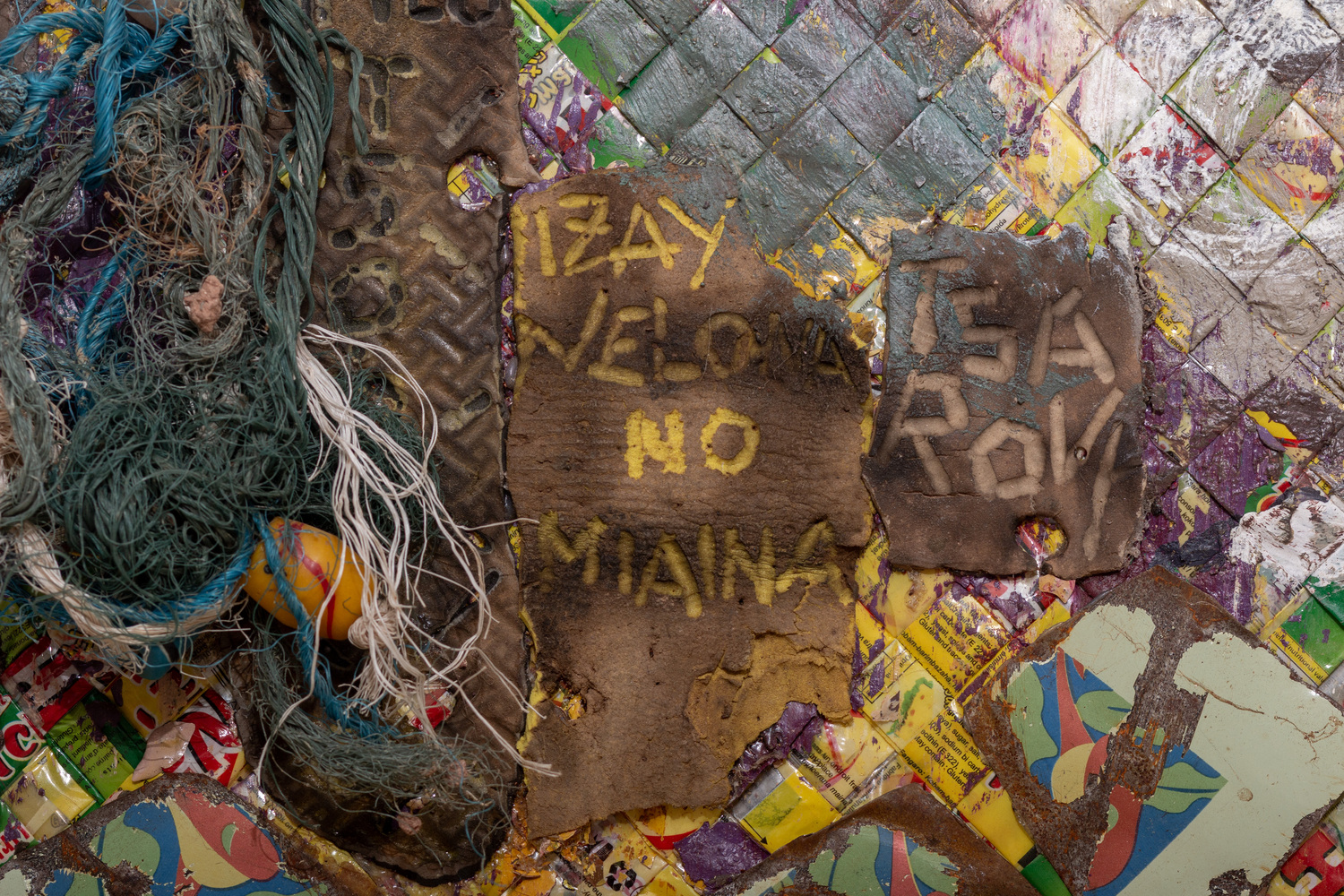
Temandrota works across drawing, painting, installation, performance and sculpture. He uses traditional materials such as sisal, soil, roots, sap, and thorns which he combines with contemporary media and recycled materials. This hybridity of material conveys his approach of creating conversations between ancestral knowledge and contemporary life.
The title Masoandro amam-bolana [Of the Sun and the Moon] is drawn from the celestial bodies which govern all living things and represents the balance of life forces drawn from the matrilineal and patrilineal lines according to Antandroy custom. Ancestors form the cornerstone of Antandroy culture and are present throughout Temandrota’s work. Ancestors are as much the earth, sky, waters, plants, and animals as they are human and all things interrelate.
The first room begins with a newly commissioned series, Saontsy (A Council of Elders), featuring a group of sculptures depicting those who would welcome visitors to the village. They are seated near a baobab tree which is a significant species for Malagasy people and are also important as a gathering place for village life. Portraits of community members hang nearby to evoke this custom of welcome and ceremony.
Temandrota has created large scale sculptures, installations and wall-based works specially for this exhibition which are in the next room and explore the significance of the land and the sea for him and Antandroy people. Earlier works from the artist’s career are displayed upstairs and demonstrate Temandrota’s long practice of exploring resources, numerology, stories, and circulation. Symbols, materials, and meanings are repeated throughout the exhibition, demonstrating Temandrota’s embrace of the cyclical meaning of time much like how the sun and the moon cycle through the sky.
Find the artworks descriptions here.
Land and Sea
Conceived and produced specifically for this exhibition, the artworks in the room are amongst Temadrota’s most ambitious works yet. The artist explores relations between the land and the sea, stemming from his experience of Androy, a dry region situated in south Madagascar, where he grew up, and his link to the people and cosmology of that land.
In Androy, where freshwater is often scarce, relationships between people, the land and ancestors are essential. Antandroy people call on the ancestors through ceremony to help find nourishment. The land belongs to ancestors and through dance, communities ask their forebears permission to wake the land.
Temandrota has developed a practice of making papers from sisal, a grass fibre which enables him to create both texture and translucency. The papers evoke the rugged terrain of land as though seen from the sky. Towards the back of the room, thirteen canoes rise vertically, in contrast with the flat landscapes in the south of Madagascar and are made from timber, connecting forests with the sea. Together, the artworks form a vast visual narrative drawn from oral tradition and scenes from everyday life.
Temandrota’s island installations bring into focus the connection between the land and the sea, with the boundaries of both overlapping each other and shifting over time. These pieces are made from found objects as well as timber, a material he often works with. Each island represents a landmark of the south of Madagascar, which are essential in Temandrota’s representation of the region. They reflect the landscape typical of the South: sand dunes, dry forests and caves.
It is said that zebus emerged from the sea. Zebus are culturally significant throughout Madagascar and they are a form of currency, transportation and food. Temandrota has created numerous sculptures in homage to these sacred bovines, mounting them on ceremonial poles placed throughout the exhibition, heralding good fortune.
To help achieve the scale of these works, Temandrota worked with a team of collaborators in his Antananarivo studio and in his village. Some have specialist skills such as traditional carvers who helped the artist carve new designs he created with permission from Androy elders. The artist also regards nature as an essential collaborator, leaving works to weather in the sun, wind and rain. Intention, collaboration and accident are essential components of Temandrota’s creative process echoing rhythms of nature and life.
Find the artworks descriptions here.
Cycles
Throughout the three decades of his practice, Temandrota repeatedly incorporates particular forms, materials, narratives and ideas as he explores the nature of cycles, in which forms are passed on, transformed and reappear in a different form. As part of this meditation, Temandrota’s work brings inherited knowledge and forms into dialogue with familiar realities of the present. It reveals Antandroy perspectives on how the visible and the invisible are closely intertwined.
Abundance is a recurring thread in Temandrota’s work, evoking generosity, sharing and gratitude expressed through a profusion of forms, materials and symbols. Whereas in the previous space ceremonial poles are mostly connected with zebus, in this room they are featured with bank notes, mobile banking and other financial resources which circulate. Across Temandrota’s practice, ceremonial poles signify wealth in different ways and its social value.
Language, phrases and especially farirotse – word play – are also explored in Temandrota’s practice. The artist often cuts out sayings from plastic packaging or fabric to include in his work as well as drawing from familiar phrases in titling his pieces. This touches on how teachings and philosophy is shared among people and carried across time through oral formats and then replicated elsewhere.
The game of fanorona has a grid pattern immediately recognisable for many Malagasy people and is associated with astrology, numerology and world order. Here, Temandrota repeats these grids which represent trajectories and forces. Other grids in his work relate to numerology in Zafimaniry architecture or ancestral knowledge and lineage passing to the living present. Distinctive symbols such as the sun and the moon and repeated materials such as discarded mobile keypads and sandals evoke the cycles of time, nature and people.
Temandrota was inspired by floor mats to create a series of textile artworks in collaboration with craftswomen from his village. Drawing on the social and ceremonial significance of weaving, textile pieces reflect the connections between individuals, the transmission of ancestral knowledge and the making of collective memory.