ANTANANARIVO
13 NOVEMBER 2026 - 24 APRIL 2027
In 2026, the Malagasy artist Temandrota, the first winner of Prix Paritana, celebrates 30 years of artistic practice. To mark this occasion, Fondation H is dedicating a monographic exhibition to the artist, Masoandro amam-bolana [Of the Sun and the Moon]. Fondation H has consistently supported and followed Temandrota’s work over the past ten years: to date, it has acquired around forty of his works, supported him in major projects such as the exhibition Madagascar: Arts de la Grande Île at the Musée du quai Branly – Jacques Chirac in 2018–2019, and provided him with opportunities to present his work on the international stage, including through his solo exhibition Barbie Caillou at Fondation H’s Paris space in 2022, preceded by a residency at the Cité internationale des arts in Paris.
Curated by Tamsin Hong and Hobisoa Raininoro, Masoandro amam-bolana [Of the Sun and the Moon] explores the artist’s visual, spiritual and philosophical universe, developing a reflection on the relationship between humanity, the living world and the cosmos. In Malagasy culture, the Sun and the Moon are the two celestial bodies that govern human existence, marking the alternation of day and night, the visible and the invisible, activity and rest. As fundamental markers of time, the Sun and the Moon invite us to embrace the cycles of life and the passing of the years. The expression amam (“and with”, “associated with”) conveys complementarity: that of the masculine and the feminine, light and darkness, presence and absence, memory and becoming. Moreover, in Malagasy, masoandro amam-bolana refers to parents, father and mother, as sources of life, guidance and light. Through the use of “du” in French and “from” in English, the exhibition’s title extends this idea of origin, lineage and transmission, which runs throughout the artist’s work. In Malagasy cosmologies, the Sun and the Moon remain constant witnesses to existence, connecting human beings, nature and ancestors across generations. In the same way, the works brought together in this exhibition observe the cycles of the world, its transformations and the invisible forces that sustain life. They reveal a way of thinking deeply rooted in Malagasy culture whilst engaging with universal questions.
Presented in Antananarivo, this exhibition offers Malagasy audiences an opportunity to appreciate the full extent of Temandrota’s inventiveness and the power of his artistic universe.
On the occasion of the exhibition celebrating Temandrota’s thirty years of artistic practice, JBE Books and Fondation H are publishing the first monographic book retracing his artistic journey. The book, introduced by Hassanein Hiridjee, President of Fondation H, and Margaux Huille, Director of Fondation H, includes curatorial texts by Tamsin Hong and Hobisoa Raininoro, an academic text by Dr. Hejesoa Voriraza Séraphin on orality and ancestral memory in southern Madagascar, as well as the artist›s own words gathered by Aude Razafindratsima. Numerous reproductions of works and a number of previously unpublished archival materials round out the book, along with views of the exhibition. Published in a trilingual edition (French, English, Malagasy), the book will be available for purchase at Fondation H’s shop in Antananarivo, online, and in bookshops internationally.
Artist’s biography
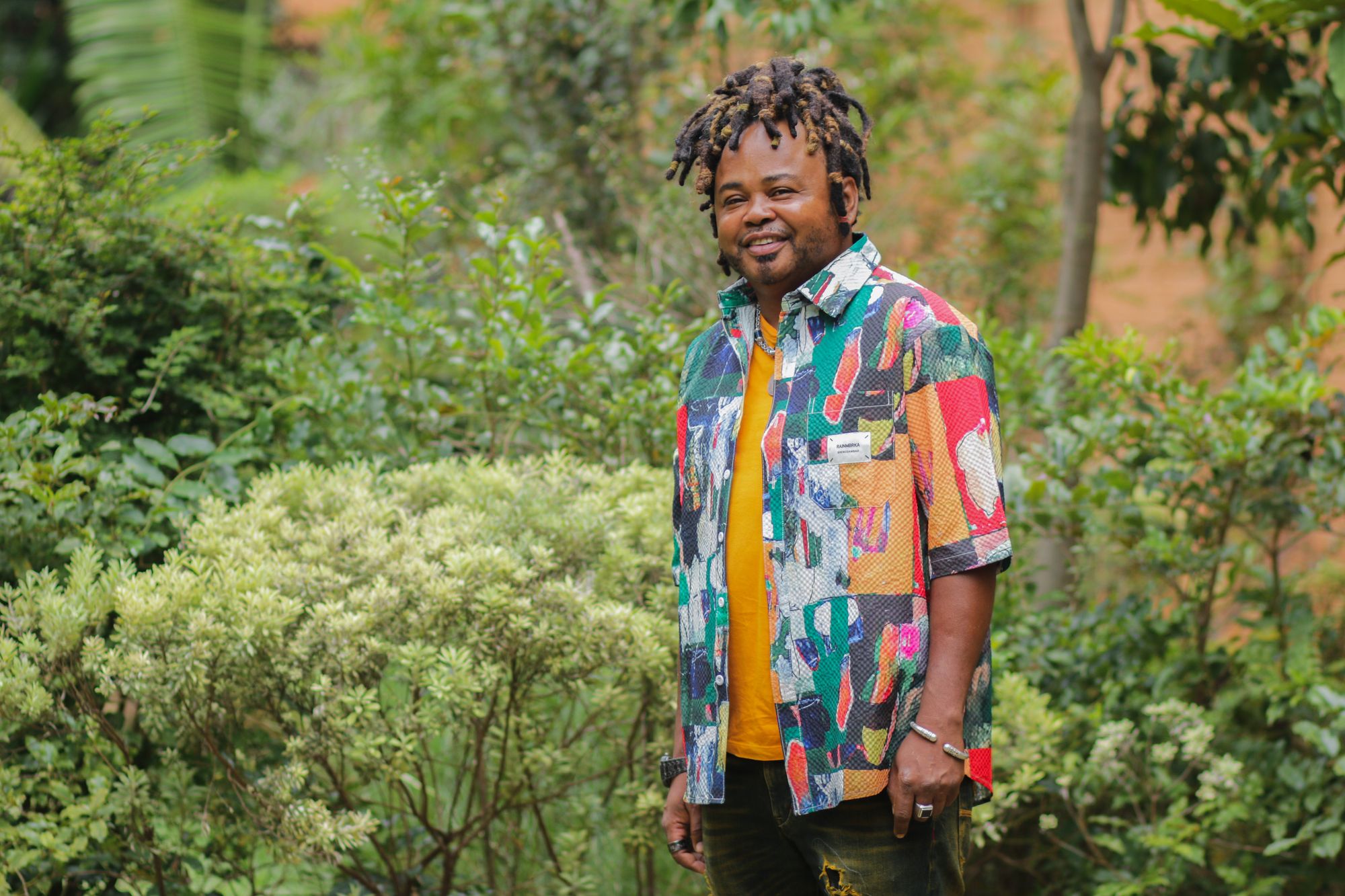
Temandrota, whose real name is Randriahasandratra Razafimandimby, is a Malagasy artist born in 1975 in Antananarivo, where he currently lives and works. Coming from a family of hunters in southern Madagascar, he was deeply affected by the kere, a famine caused by drought in this arid region, which influences his creative process both in the subjects he explores and the materiality of his work. His artistic approach incorporates intangible aspects of the culture of the Far South of Madagascar, such as nomadism, spirituality, traditional storytelling and oral tradition. His work, which spans a variety of media (painting, sculpture, installation, performance), draws its inspiration from the culture of the Tandroy people, a community in south-eastern Madagascar amongst whom he grew up. The strength of Temandrota’s work lies in his ability to weave an artistic language deeply rooted in the realities of the territories he travels through, his anchor lands, whilst maintaining a distinctly contemporary feel. In his works, he uses natural materials that he collects along the way, such as earth, sisal, roots, wood, sap and leaves, which he generally combines with recycled objects, or even waste that he collects from the rubbish dumps of Antananarivo.